
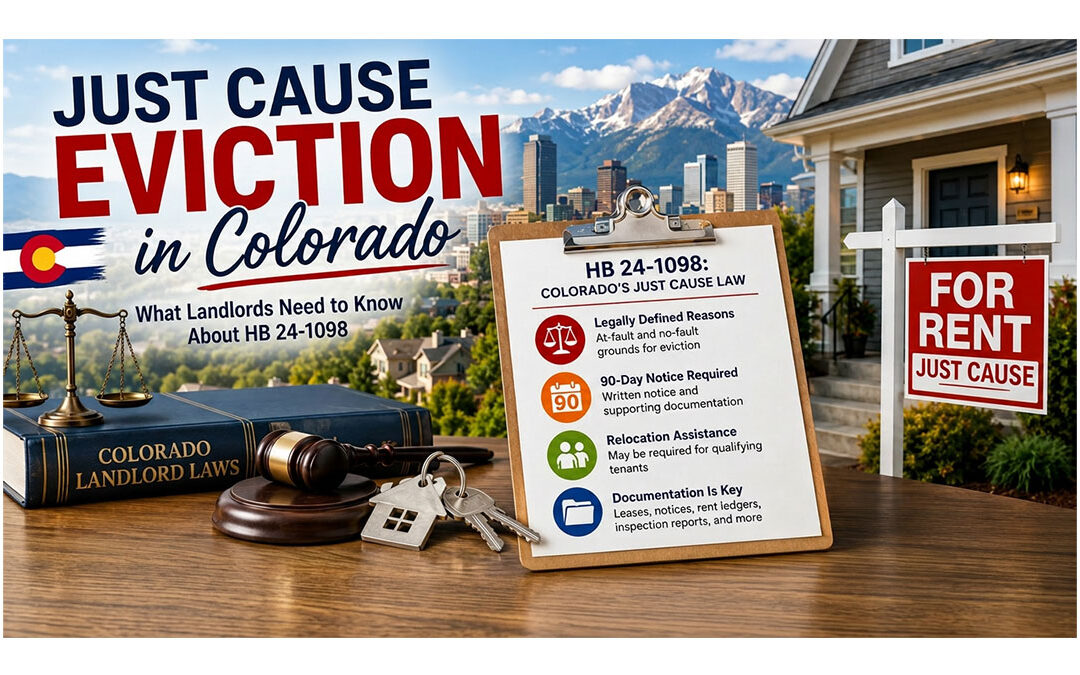
Just Cause Eviction in Colorado
For decades, a Colorado landlord could simply decline to renew a lease upon expiration, with no explanation required. That ended on April 19, 2024, when House Bill 24-1098 took effect. Colorado is now a “for-cause” eviction state. Landlords must have a legally recognized reason to evict a tenant or decline to renew a lease, and must have documentation to support the decision.
For Denver-area rental property investors, the law significantly increases the importance of tenant selection, lease timing, and property planning. At DenCO Property Management (DenCO), we have watched Colorado’s tenant rights regulations steadily increase over the past several years. HB 24-1098 is the most consequential of those changes. Landlords who proactively comply will be in a much stronger position than those who do not.
What Actually Changed
Now, a landlord must have a legally defined cause to evict. The law ends tenancy in two ways: at-fault evictions, where the tenant did something that justifies termination, and no-fault evictions, where the landlord has a legitimate business reason unrelated to the tenant's behavior. At-fault evictions occur when tenants violate the lease or fail to meet a legal obligation. Such as:
Nonpayment of rent: Property managers must maintain a payment ledger for each rental property they manage, showing due dates, payments received, late fees assessed, and the outstanding balance. Any 10-Day Notice to Pay or Quit notices served must be documented. Landlord who keeps vague or incomplete rent records face both financial and legal risks.
Curable lease violations: Unauthorized pets, unauthorized occupants, noise complaints, and property damage are examples of curable lease violations. These require a 10-Day Notice to Cure or Quit that clearly states the specific violation and explains how to fix it, plus objective evidence of the issue — photographs, inspection reports, or written complaints. All correspondence with renters must be retained because verbal explanations of violations will not hold up in court.
Substantial or criminal violations: Illegal activities, violent crimes, and threats to safety are non-curable and must be addressed promptly. These require only a 3-Day Notice to Quit, supported by police reports or affidavits documenting the activity or danger.
No-Fault Evictions: The 90-Day Reality
The law requires that tenants be given 90 days' written notice and supporting documentation of the stated reason. Property managers should allocate time to collect and organize documentation before sending the notices. The accepted no-fault reasons are:
Owner or family occupancy: The owner must present a signed affidavit stating intent to occupy to the renters.
Demolition or property conversion: The rental will be demolished or remodeled for another use. The landlord must present copies of building permits, planning approvals, and other official filings to tenants.
Substantial repairs: The owner decides to undertake major repairs to the rental and present proof that the tenant must vacate the property to complete the project. Routine maintenance does not qualify as substantial repairs.
Withdrawing the property from the rental market: The owner has decided to sell or withdraw the unit from the rental market. Property managers must present a listing agreement and cannot re-rent the home for a specific period if it does not sell.
If a tenant is over 60, has a disability, has children under 18, or earns under 80 percent of Area Median Income, the landlord may be required to offer 2 to 3 months’ rent in relocation assistance. Failing to provide it can invalidate the eviction entirely.
Why Tenant Screening Matters More Than Ever
Tenants who understand the system can use procedural defenses to remain in place for months while a case works its way through the courts. Income verification, credit evaluation, background checks, rental history, and reference checks are no longer just good practice — they are the primary defense against a problematic tenancy. HB 24-1098 makes the adage that a bad tenant creates ten times more work than a good one even truer now.
Documentation Is a Landlord’s Primary Protection
Below are the key documents under HB 24-1098 that landlords must keep.
- The original, fully executed lease and all amendments.
- Any written notice that clearly states the legal reason and complies with statutory language.
- Proof of service — a signed affidavit, photographs of a posted notice, or certified mail receipts.
- Rent ledger for each property.
- Written records of all communications, reminders, and warnings as they happen.
Improper notice is one of the most common reasons eviction cases get dismissed. A missing affidavit, a notice that does not use the required statutory language, or a gap in the rent ledger can undo an otherwise legitimate case.
What This Means If You Are Self-Managing
HB 24-1098 raises the operational bar for every Denver landlord, even those who self-manage. Self-managing owners need to track notices, service proof, communication logs, and statutory deadlines correctly the first time — there is little room for error once a filing is made, and a single documentation mistake can delay an eviction by months or get the eviction dismissed. Click here for more information about deciding whether to self-manage or not.
Plan Around This Law, Do Not Just React to It
HB 24-1098 has permanently changed how evictions and non-renewals work in Colorado. The best way to avoid compliance issues is to proactively manage and track all financial transactions and communications with renters. Landlords who wait until a tenancy goes wrong will have a crash course in Colorado's Just Cause Evictions law.
Rental property owners who are unsure or need help navigating Colorado’s evolving tenant rights regulations should consider professional management. At DenCO, we would like to earn your business. We have managed Denver rentals since 1999, including over 200 homes, condos, and apartments across Washington Park, University Park, Bonnie Brae, Platte Park, and Englewood. Need professional property management services? Please call (303) 722-9688 or click here to complete a request service form.
Recent Comments