
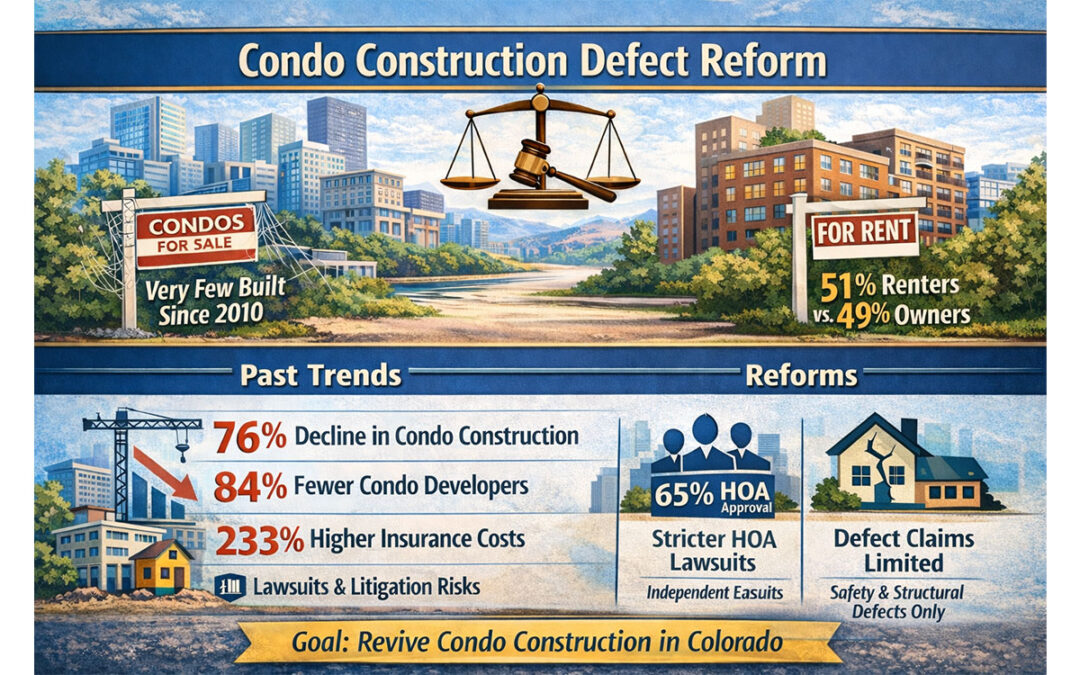
DenCO Property Management (DenCO) has managed Denver rental properties since 1999, and most of the condominiums we manage today are more than 15 years old—because very few have been built since the condo market collapsed around 2010. That collapse followed well-intentioned but not well-thought-out construction defect reforms signed by Democratic Governor Bill Ritter that dramatically increased litigation risk, doubled insurance costs for apartment projects, and pushed builders out of the for-sale condo market. As a result, entry-level condos disappeared, and homeownership became harder for young buyers, delaying their ability to build wealth. So, most young people in Denver rent. As of late 2025, approximately 51 percent of households in Denver are renters, while the remaining 49 percent own their homes. In comparison, in Nashville, Tennessee, 52 percent are homeowners. The lack of condos contributes to Denver’s affordability crisis, a topic often mentioned by politicians. Let’s hope HB25-1272 brings more reasonably priced housing to the market. Click here to read DenCO’s blog titled “Where Have the Condos Gone, Long Time Passing.”
Trends
- Construction trends: Condo development dropped 76% between 2002-2008 and 2018-2022.
- Builder numbers: The number of condo developers in Colorado fell 84% from 146 in 2007 to 23 in 2022.
- Legislative changes: Major reforms in 2003, 2007, 2010, 2017, and 2025 (most recently HB25-1272)
- Economic impact: Insurance costs for condos are 233% higher than single-family homes due to litigation risk
HB25-1272, known as the Colorado American Dream Act, was signed into law by Governor Jared Polis on May 12, 2025, and represents the state’s attempt to revive condominium and townhouse construction in the state. The bill creates the Multifamily Construction Incentive Program (MCIP), a voluntary framework that builders may opt into beginning January 1, 2026. Participating builders must provide written warranties covering one year for workmanship and materials, two years for plumbing, electrical, and mechanical systems, and six years for structural components. They must also submit to independent third-party inspections during construction to identify issues early. For projects enrolled in the program, construction claims are limited to defects that affect safety or cause substantial damage, rather than minor or cosmetic concerns.
The law also restructures how defect claims proceed. Builders must provide written responses explaining applicable standards and why repairs may not be required, and claimants must respond within defined timelines. Design-related claims must be supported by written statements from licensed design professionals, not just from homeowners, HOAs, or attorneys. If monetary judgments are awarded, these funds must first be used to repair the alleged defects, although the statute is vague regarding the priority of attorney fees. Another notable change is the creation of a rebuttable presumption that a building is defect-free once it receives a certificate of occupancy, shifting some burden of proof back onto claimants.
A rebuttable presumption is a legal assumption that something is considered true unless someone proves otherwise. For example, buildings are considered defect-free once they receive a certificate of occupancy. However, homeowners or HOAs can still overcome that assumption by presenting credible evidence showing real defects exist.
Supporters of HB25-1272 believe the law could jump-start condo and townhouse development by improving legal certainty and encouraging insurer participation. A major first step began on August 6, 2025, when homeowner associations must obtain approval from at least 65 percent of unit owners before filing a construction defect lawsuit, up from a simple majority. The higher threshold reduces the likelihood of lawsuits being driven by small, unrepresentative groups and adds more predictability for owners, investors, and builders. Colorado’s Commissioner of Insurance hopes that increased competition among insurers could eventually moderate premiums. However, skepticism remains. Industry groups note that the law still lacks a precise definition of what constitutes a “defect,” litigation incentives remain strong, and insurance costs may not fall.
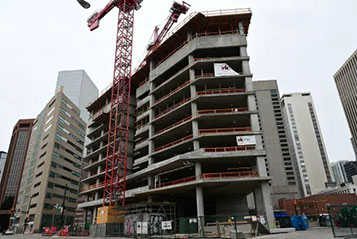
It is too early to judge the success of MCIP since the program starts next year. In 2025, only a few condominium projects have broken ground in Denver. One notable example is the Waldorf Astoria Residences in Cherry Creek, a luxury condominium project that started construction in late 2025 after selling a majority of its units in advance. New condo construction is occurring at the very top of the market, where pricing can absorb higher insurance and legal costs. Another major project, the Upton Residences, a large two-tower downtown condominium project, is offering units starting in the mid $300,000s. Beyond these, most other proposed condo developments in Denver remain in early planning or permitting stages, with few having moved to active construction. The slow pace highlights how deeply the condo market was suppressed over the past decade and suggests a wait-and-see attitude from investors, builders, and insurance companies.
DenCO continues to monitor real estate changes closely as part of our commitment to helping owners understand evolving regulations and long-term market trends. We currently manage approximately 175 rental homes, townhomes, and condominiums across Washington Park, the DU area, and surrounding Denver neighborhoods. If you would like to discuss how these changes may affect property values and investment strategies, please call 303-722-9688 or fill out this form.
Recent Comments