

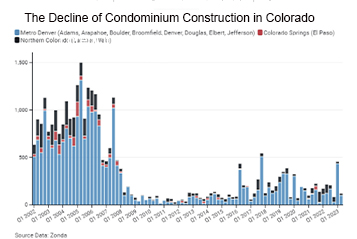
DenCO Property Management (DenCO) has been managing rental properties in Denver since 1999. We manage homes, townhouses, and condominiums. Interestingly, most of the condos we manage are at least 15 years old or older. The condo market in Colorado died in 2010 following property and casualty insurance changes.
Why Did The Condo Market Die in Colorado?
Governor Ritter’s and the Legislature’s intentions were good – protect buyers of new condos from construction defects but the trial lawyers have laughed all the way to the bank for over a decade and a half. The new law caused insurance costs for condos to surge over two times higher than apartment construction. Affordable condos, once available in the $300,000 range in Denver, disappeared. Today, buyers need to save over a hundred thousand dollars to put down for single-family homes. Most young people do not have that capital, forcing them to rent and exacerbating the housing affordability issue in the state. Suppressed home ownership stifles wealth generation and makes Colorado less attractive to young people early in their careers. Also, condominiums with good locations make good long-term investments. Condo rental investors have avoided the Denver market for over a decade.
Maybe HB 1272 Will Change This
In 2025, the Colorado legislature worked with all stakeholders to get a bill to Governor Jared Polis’s desk. He signed House Bill 1272 this May. Backers hope the Bill will breathe new life into Colorado’s condominium construction market by introducing several changes to create a more favorable environment for condo construction while still protecting homeowners. The most promising is the Multifamily Construction Incentive Program (MCIP). Next year, developers can opt into this voluntary program, which offers legal protections in exchange for adherence to specific construction standards. Its provisions include:
Builder Requirements
Warranties: Builders must provide warranties covering one year for workmanship and materials, two years for systems like plumbing and electrical, and six years for structural components.
Third-Party Inspections: A third-party independent inspector must be hired to perform periodic checks during construction. Inspectors cannot be affiliated with the builders.
Defect Limitations: Limit actionable construction defect claims to significant issues affecting safety, usability, or causing substantial damage.
Legal Protections
Structured Claim Process: The Bill attempts to put more structure in the defect claim process by adding the following steps:
- After a claimant identifies an issue, the builder must offer a written response identifying applicable standards and explaining why the defect does not require repair.
- Claimants have 30 days to respond.
- Claimants must submit a certificate from a licensed professional when alleging design defects and specify how the claim will be satisfied.
Statute of Limitations Changes: The current statute of limitations for filing construction defect claims is ten years. However, if the builder provides a warranty that meets the requirements of the MCIP, the statute of limitations is six years.
Use of Settlements: Claimants must use any settlement proceeds to address the defects, plus attorneys’ fees. What takes precedence is unclear, paying for the repairs or attorney’s fees.
HOA Voting Threshold: The Bill increases the HOA voting threshold from 50 to 60 percent to sue.
Presumption of Compliance: Establish a rebuttable presumption that a building is free of defects if it has received a certificate of occupancy. A rebuttable presumption allows a court to assume a fact to be true unless sufficient evidence is presented to prove otherwise. The burden of proof lies on the party challenging it, lowering litigation costs for the defendant.
Will It The Condo Construction Come Back in Colorado?
There is a range of opinions on whether HB 1272 will revive the condo market in Colorado. However, you have to credit the Colorado legislators for getting a bill passed and signed by the Governor. Construction Defect litigation is big business here. Recent job postings indicate a range of $120,000 to $200,000 for construction defect attorneys in Denver.
Optimistic Views
Supporters hope the Bill will make home ownership more affordable in Colorado because condominiums present a lower entry point for first-time buyers and people wanting to downsize. Colorado’s Commissioner of Insurance believes the market will increase demand for construction defects liability insurance. Competition could bring down insurance premiums to a more affordable level for builders.
Pessimistic Views
The Colorado Association of Homebuilders believes the primary problem is the lack of a clear definition of a “defect.” They suggest that defects should be actual damages, not merely technical code violations that do not impact the structure or habitability. The Bill’s lack of definition means more litigation, meaning premium costs for construction defects liability insurance could remain high.
HB 1272 represents a significant effort to tackle the complex issues that decimated Colorado’s condo construction market. By implementing third-party inspections, clarifying the claim processes, adjusting statutes of limitations, and ensuring settlement money goes towards repairs, the Bill aims to balance builder concerns with homeowner protections. Only time will tell if this reform package can unlock Colorado’s condo market. The Governor directed the Department of Local Affairs to track how many builders participate in the new program and how many units are constructed. All intentions are good, but if developers do not participate, it’s doubtful that they will start building condos again.
DenCO fully supports the effort to revive Denver condominium construction and sees it as an opportunity to bring more units under its management. We believe in informing its owners of real estate trends and tenant rights regulations. We have been in business since 1999 and manage 175 rentals in the DU, Washington Park, and other Denver neighborhoods. Please call 303-722-9688 or fill out this form on the contact page. Please call 303-722-9688 or fill out this form on the contact page.
Recent Comments