


Understanding Colorado’s housing trends requires keeping up with the market. Below is a summary of Redfin’s April 2024 housing report. Redfin is a popular real estate brokerage buy and sell application.
Home Sales Prices On A Median Basis
The median sale price in Colorado was $621,800, a 7.4% increase from the previous year. Since the 1970s, people have been moving to Colorado for jobs and to embrace the state’s natural beauty, which means more demand, pushing up residential rental prices, making it one of the most expensive states to live in.
Home Sales In April 2024
In April, 6,805 homes were sold in Colorado, an increase of 4.7% over last year. This metric gives us a good idea of Colorado’s early 2024 sales volume. Nevertheless, the sales volume might be overstated since home sales usually peak in the spring and summer and decline in the winter.
Days on Market (DOM)
The average number of days a house remains on the market before being under contract is called the days on the market (DOM). The DOM in a seller’s market is lower, indicating higher offer levels and fewer buyer contingencies. In April, the Colorado home sells in 25 days on average after it is listed. The number grew higher to 51 in September. Have you noticed all the for-sales signs in neighborhoods like Washington Park, Bonnie Brae, and Virgina Vale? The market has cooled.
Housing Supply
Denver can expect 46,000 apartment units to become available in 2024, and another 75,000 units are in the pipeline. Some of these projects are near or in Denver’s most popular neighborhoods. The large complexes typically have heated underground parking, a pool, and other comforts. Institutional investors financed many of these multi-family complexes, which gives them the luxury of offering steep rental and deposit concessions to attract tenants, which may put downward pressure on rents.
Ask any Colorado legislator, regardless of party, what they believe to be one of the most significant issues facing the state, and there is a high likelihood they will say housing. State lawmakers and city governments are grappling with affordable units for first-time homebuyers or empty nesters wanting to downsize. Condo and townhouse construction has plummeted since 2003. One of the primary reasons is the state’s Construction Defect Action Reform Act (CDARA). The building and real estate industry warned Governor Ritter that the new law would cool the development of condos and townhouses in Colorado, but he signed it into law that year. The lack of affordable units for first-time homebuyers is self-inflicted and hard to remedy because of the power of the Trial Lawyers Association in the Colorado Democratic party, which resists reforming the CDARA. A major reform attempt in 2024 in the Colorado legislature backed by several prominent Democrats and homebuilders, construction groups, and economic-development organizations never got out of committee.
Economic Factors
Denver Metro Area
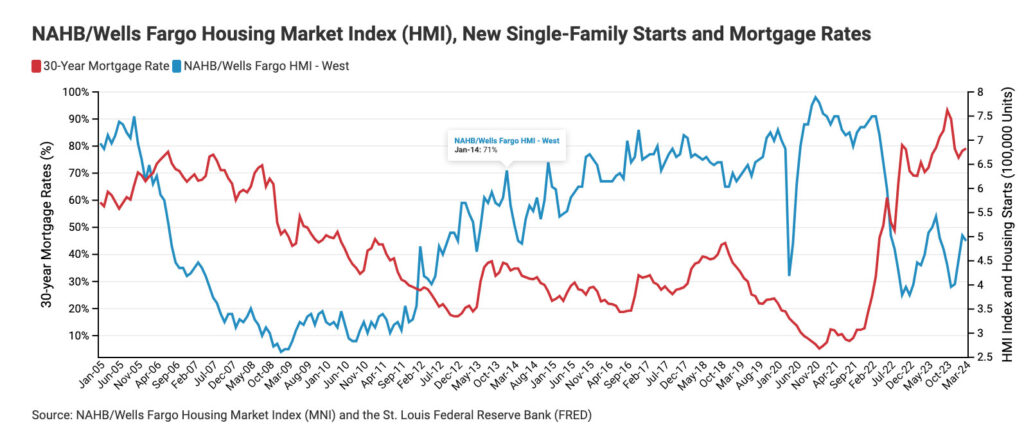
The December Housing Market Index (HMI) (blue line) on the chart released by the National Association of Homebuilders for the Denver market reflects builder confidence in the market for newly-built single-family homes. The HMI is a monthly survey of single-family builders who rate three specific conditions of the housing market:
- Present sales of new single-family homes
- Expected sales of single-family homes for the next six months
- The traffic of prospective buyers of new single-family homes
Each month, the HMI depicts overall builder sentiment toward housing market conditions on a scale of 0 to 100. A reading higher than 50 indicates that the majority of builders feel confident about the current and near-term outlook for housing. Lower readings signify less optimism among builders. The HMI fell for the 10th month to the lowest point since April 2020. If builders in Denver reduce new construction, which looks increasingly likely, the housing unit deficit will likely increase. If population growth continues as forecasted and single-home construction decreases, the housing deficit in Denver will grow forcing prices up.
Mortgages Rates
Before 2020, home buyers took advantage of low interest rates to buy houses. Over the last three years, inflation has driven rates up to the seven percent range, with a slight dip lately. High rates discourage borrowers from borrowing and homeowners from selling their homes. Sellers do not want to give up their low-interest mortgage rates, so they are “locked in” to their current properties. Homeowners with a three percent mortgage or lower are happy about their low monthly payments and are not in the mood to sell.
Double Whammy of Inflation and Living Costs
This year, on average, all Coloradans pay much more for groceries, gas, insurance, and other living expenses, which lowers their ability to save money for a down payment and pay a high-interest mortgage. Fifty-one percent of the households in Denver are renter-occupied.
Slowing Population Growth
The rush of higher-educated people coming to live in Colorado has slowed. In 2022, Colorado’s outflow exceeded its inflow for the first time in memory. Colorado has lost its luster for several reasons. High housing costs are a leading factor. Migration patterns have attracted many people from California and large cities in the East who brought their progressive politics with them. Colorado’s large urban areas, especially Denver, Boulder, and other Front Range cities continue to be strongholds for the Democratic Party. These areas have seen population growth, with a younger, more diverse, and progressive electorate forcing one-party rule. One-party rule eventually overreaches and enacts anti-growth laws and regulations, changes laws that increase crime and homelessness, and passes tax increases, making Colorado less attractive than pro-growth and low-tax states like Texas, Florida, and other southern states.
2024 Colorado’s Housing Predictions
The yin and yang of the above mentioned factors mean Colorado’s real estate market will become more balanced in the second half of 2024, which means home buyers and investors will have more buying opportunities in Colorado for the rest of the year. Redfin does not predict a shift to a buyer’s market. Updated home rentals in desirable neighborhoods with nice amenities should be able to demand high rents. Older one- and two-bedroom units might experience pricing pressure because of the increase in new apartment complexes coming into the market this year. DenCO Property Management (DenCO) hopes the current market softness is seasonal and not fundamental.
Life happens, and sometimes homeowners need to sell. Recent owners who look at commissions, time on the market, and fix-up costs realize they will lose money at the closing table. Since they cannot sell their homes at the price they need, they decide to rent instead. Please check out our blog titled “What Do You Do If You CanNot Sell Your House in Denver?”
Home and condo rentals must be clean and in good repair in soft markets to attract good tenants. Their monthly rents must be priced right based on location and market conditions. Owners looking for professional property management services should call DenCO Property Management. We have been in business since 1999 and are experienced in operating in hot and soft Denver rental markets. Call us at 303-722-9688 or click here to complete a Contact Us form.
Recent Comments