


Breaking News – Denver’s Green Mandates Paused
According to the Denver Gazette in their January 14, 2025 editorial titled City Backs Down on ‘Energize Denver,’ The City of Denver postponed a deadline for large building owners to comply with the green mandates of Energize Denver. It terminated targets due in the next three years. If Denver had fully implemented their green mandates, the ripple effects would have been soaring rents and retail prices to cover the costs of converting heating systems from gas to electric in a downtown real estate market already facing high vacancy rates. The economic damage would have been catastrophic to downtown Denver. The heat pump technology touted by the City cannot heat large buildings effectively. Also, Xcel does not have the electricity to heat all these large buildings on cold days. We guess that they wanted everyone to wear sweaters when working. The green mandates passed by the Denver City Council in 2021 were poorly thought out, based on unrealistic assumptions, did not consider economic impact, relied on untested technology, and were simply impractical.
Lawsuits Work
Both the State’s and City’s rules were being challenged in federal court by property developers and owners who said the rules were unfair and costly. Their case stated that the City’s green regulations are based on impossible-to-meet energy savings targets that violated standards set by the federal Energy Policy and Conservation Act. Colorado should follow Denver’s lead. Governor Polis and the Legislature should remember that any cure to a crisis should not be worse than the ill.
As discussed in our last blog post, Democrats made significant gains in Colorado six years ago, giving them total dominance over the state government. One-party rule usually leads to the dominant party overreaching politically. Case in point, Governor Polis’s goal of getting Colorado to 100 percent renewable energy use by 2050 faces economic, legal, and technology headwinds that will most likley prevent the State from achieving this lofty green energy goal.
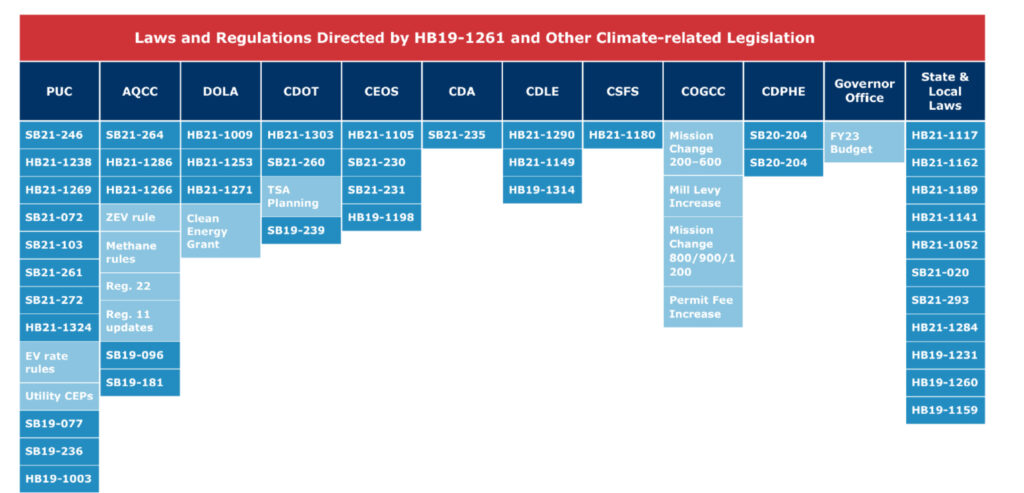
According to Colorado Politics, Polis pledged when first elected in 2018 “to move the state toward renewable energy relies on innovation and encouraging market solutions, not the mandates Stapleton warns will soak consumers.” However, Polis and the Colorado legislature immediately started working on a wide range of proposals to decarbonize the Colorado economy. The chart below shows that they have been busy enacting new green energy laws.
Common Sense Institute Colorado
Each of these laws needs people to manage all the programs enacted. For example, the Colorado Energy Office (CEO) has 78 people listed on its website as staff, which is most likely a partial list of all employees at this state agency. In July 2024, the Environmental Protection Agency (EPA) awarded the CEO $129 million in Climate Pollution Reduction Grants to improve Colorado’s air quality and reduce greenhouse gas emissions. The CEO is flush with federal money, and their mission is to “develop programs and promote energy policies to fight climate change, improve air quality, and save Coloradans money.” That is all well and good, but they fall short of “saving Coloradans money.”
According to the Find Energy website, Colorado’s average monthly residential electric bill is $102.43. Colorado is the third most expensive state in the country in terms of the cost of electricity. Xcel’s base rate ten years ago was $0.04604/kWh. In January 2024, it was $0.07136/kWh, a 55 percent increase. Gasoline prices have doubled from four years ago. CEO and similar state agencies dealing with the green agenda are making Colorado an expensive place to work and live.
The Climate Change Crusade
The United States emitted the most greenhouse gases as it industrialized and became a great power in the 20th Century. However, environmental laws and regulations enacted in the Nixon administration give America some of the cleanest air and water today. According to a recent Common Sense Institute article, “Colorado Faces Barriers To Meeting Goals,” China and India are now the world’s top annual emitters. Between 2005 and 2020, annual global carbon dioxide emissions increased by 5.8 billion metric tons, a 20 percent increase. China accounted for 92 percent of that increase. During the same period, the U.S. led the world in cutting carbon dioxide emissions by 24 percent, while China’s emissions rose 84 percent. China pledges it will be carbon neutral by 2060, but it is apparent from China’s actions that they are not honoring that commitment. In 2020, China permitted 163 gigawatts of new coal power projects, over five times more than that initiated in the rest of the world combined. People should look at what people do versus what they say—even nations.
The U.S. and Western Europe are committed to decarbonization, but China and India are not. Ironically, China’s and India’s emissions negate most of the climate change efforts in the U.S. and Western Europe. Obviously, the leaders of China and India do not believe Representative Alexandria Ocasio-Cortez when she said four years ago, “The world is going to end in 12 years if we don’t address climate change.” Many people believe this nonsense; unfortunately, some work in our State’s agencies or hold office in our General Assembly.
A False Dilemma
The discourse surrounding climate change gets people stuck in binary arguments: climate change does or does not exist and whether climate change is caused by humans or naturally occurring. One side thinks the other is stupid, misinformed, or worse, so it becomes difficult to find a solution because of disagreement on first principles. Governor Polis and our Democrat Legislature ignore the economic pain their policies cause because they believe they are on a mission – saving the planet damn the cost and geopolitical consequences. Or, they like having the power to tell people what to buy, how to behave and live because they know best.
Economic Pain
It is hard to ask people to make choices contrary to their economic interests. They might do it once or twice, but most Coloradans will pick economic vitality over hardship. The bureaucrats in the growing number of state agencies involved in the decarbonization of Colorado long ago lost touch with the average Coloradan battling to pay their mortgages, put food on the table, buying gas for their transportation needs. High energy costs and 20 percent inflation drastically reduce the middle class’s spending power. Many families live paycheck to paycheck. The challenges of running a business in Colorado are high with mandated minimum wage and family leave policies, a slow economy, high inflation, lack of access to capital, and labor shortages. Mandates to force businesses to transition from fossil fuels toward zero-carbon electricity might be the straw that breaks the camel’s back.
Technology and Material Barriers
It is tough to meet aggressive green energy goals when the technology and materials needed to meet them do not exist or are scarce. Also, these lofty goals put enormous pressure on renewable technology to function reliably 365 days a year when its performance is intermittent. Basically, the physics is not right. Utilities generating electricity from wind and solar farms must store the energy when there is no wind or sunshine. Battery storage technology at this scale is difficult, expensive, and technologically challenging. The exaction of copper, lithium, cobalt, and nickel needed for advanced battery technology is usually problematic and harmful to the environment. The U.S. has reserves for most of these elements, but the permitting process takes years, if not decades. Hence, most of these materials come from China, which is known to use its position to restrict exports when trade or geopolitical tensions increase. Without large-scale battery technology, it will not be easy to meet Colorado’s 2050 zero-emission goals. Nuclear power plants might be the answer, but it takes decades to move projects through the permitting process and then build them.
Commercial Building Owners Are About to Get Soaked
In Colorado, the Building Benchmarking and Performance Standards aim to enhance energy efficiency and reduce greenhouse gas emissions in commercial, multifamily, and public buildings of a specific size. These standards are called Regulation 28. Owners of covered buildings are required to measure their energy use and compare it against similar structures to identify opportunities for improvement. However, many of the standards building owners are requested to meet were established before the state agencies collected any use data, so these standards are guesses. Colorado businesses are concerned about the costs and timeline of Regulation 28. According to a white paper published by Brownstein, a prominent Denver law firm, industry experts estimate that compliance with Regulation 28 could cost over $3.1 billion, or an average of $387,500 per building. Some say that the costs are unrealistic, given the financial challenges faced by the building industry.
Commercial property owners nationwide, including in Colorado, face high vacancy rates. The office sector has been hit hard due to ongoing remote work trends and companies downsizing office spaces. Denver’s office vacancy rate in the third quarter of 2024 increased by 30 basis points quarter-over-quarter, amounting to 24.7 percent. New class A office buildings with great locations are fine, but most older office stock is probably underwater. For example, the Republic Plaza, one of Downtown Denver’s signature high rises, defaulted on its loan, but its owners have renegotiated a workout package. The property’s value dropped 44 percent from its previous valuation. Any return on retrofitting its energy plant to electricity is doubtful, and the cost will probably bankrupt the owner.
Eventually, businesses say enough is enough, and they cannot take it anymore and start to push back. The Commercial Real Estate Development Association (NAIOP), Colorado Apartment Association (CAA), Apartment Association Of Metro Denver (AAMD), and Colorado Hotel And Lodging Association (CHLA) have filed a lawsuit against the Colorado Air Pollution Control Division, Colorado Energy Office, Energize Denver and all the officials who run these agencies including the mayor of Denver. The plaintiffs challenge Colorado’s Regulation 28 and Denver’s Energize Denver Ordinance, establishing building performance standards to reduce greenhouse gas emissions. They argue that these standards require building owners to replace existing appliances with products exceeding federal energy efficiency standards, thereby conflicting with the federal Energy Policy and Conservation Act. In response, the defendants filed motions to dismiss, stating that the plaintiffs cannot demonstrate specific injuries and that their alleged harms are speculative. The court has yet to issue a final result, and the case remains pending.

How Trump Reshaped the Election Map – New York Times
Trump’s Win
The days of the Federal government spending trillions of dollars on climate change initiatives are over with Trump winning the 2024 Presidential election. The graph above shows how the country shifted to Republican control since 2012. The Colorado Air Quality Control Commission, Energize Denver, and the Colorado Energy Office got $587 million in federal funds in 2024 alone. With former Republican Representative Lee Zeldin heading the EPA and Elon Musk and Vivek Ramaswamy looking for ways to slash excess regulations, cut wasteful expenditures, and restructure Federal Agencies, these monies will likely dry up. The focus of the Trump administration will be to expand domestic oil and gas extraction, not limit it.
Reality Check
Colorado’s Democrats have been on a roll since 2018 and are not used to political setbacks, but they are starting to stack up. They got one last year when the voters soundly defeated Governor Polis’ Proposition HH. Last August, Advance Colorado and Colorado Concern out-maneuvered Polis and the Legislature by getting them to pass and sign Colorado House Bill 1001, lowering property taxes and limiting government growth. In November, Republicans flipped three Colorado House of Representatives seats, costing Democrats their supermajority. The voters sent a clear message – they are not willing to sacrifice their economic well-being for nebulous social and cultural causes and reject Democratic policies that push for higher taxes and fees. However, Democrats remain in firm control of every branch of state government, but maybe they are looking over their shoulders more now.
A desire to address climate change should not be taken as a blank check for implementing environmental policy and regulations. There should be a balance between moving to renewable energy and not sacrificing affordability for Colorado families and businesses. Before investing in building upgrades and equipment changes mandated by Denver and the State of Colorado, property owners and companies should wait and see what the court decides on the NAIOP, CAA, AAMD, and CHLA lawsuit. Also, the enforcement ability at the state and city levels might become limited because of a lack of funds. The time may come when elected officials in Colorado take a hard-nosed look at the benefits of decarbonization and decide if they are worth the fiscal and economic harms. They must exit the otherworldly space where stopping climate change became a religious mission for moral redemption.
Rental Property Owners
DenCO Property Management (DenCO) believes residential property investors need to pay attention to what happens to Regulation 28 in the courts because many of its requirements might eventually be applied to homeowners if the City of Denver and state agencies win. Embolden, these agencies may force many of these requirements onto homeowners and smaller building owners when they need to replace a furnace or buy a new appliance.
DenCO believes its job is to keep its owners informed about local and state rental regulations and to keep all properties compliant under its control. DenCO manages over 175 rentals in the DU, Washington Park, and other neighborhoods in the Denver area and has been in business since 1999. Call us at 303-722-9688 or click here to complete a Contact Us form.
Recent Comments